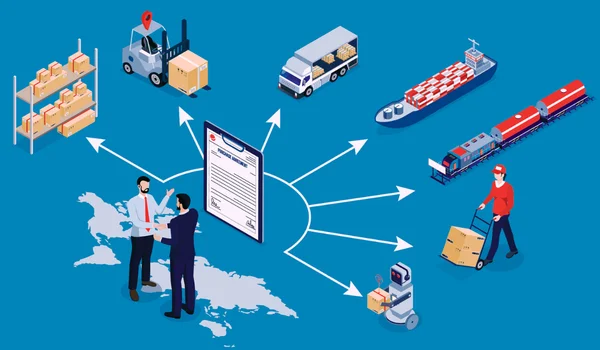
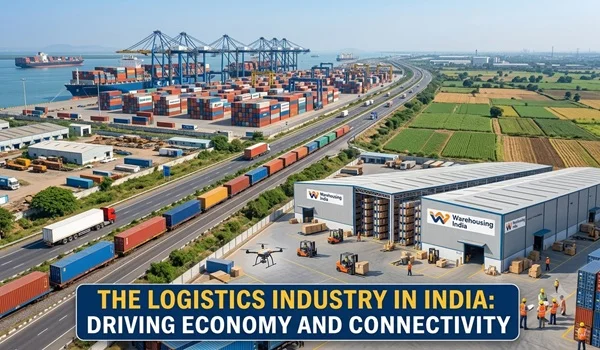
The logistics supply chain in India connects manufacturers, suppliers, warehouses, distributors, retailers and customers. It ensures that raw materials reach factories and finished products reach the right market at the right time.
India’s supply-chain network covers road, rail, air and maritime transportation along with warehousing, inventory management, freight forwarding, distribution and last-mile delivery.
As manufacturing, e-commerce, retail and exports continue to develop, efficient logistics supply chains have become increasingly important for Indian businesses.
What Is Logistics Supply Chain?
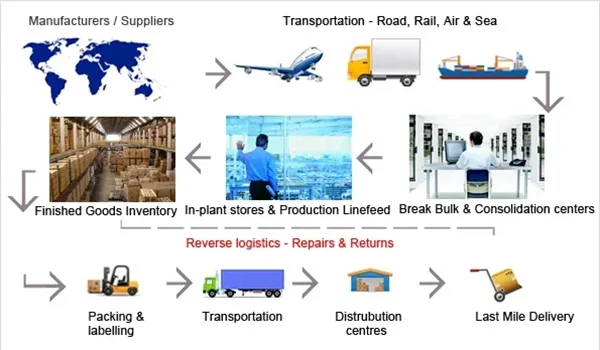
A logistics supply chain is the complete network involved in sourcing, storing, moving and delivering products from suppliers to final customers.
A simplified supply chain looks like:
Supplier → Manufacturer → Warehouse → Distributor → Retailer → Customer
Logistics is an important part of this system because it manages the physical movement and storage of goods.
A modern supply chain may also include:
- Procurement
- Inventory management
- Transportation
- Warehousing
- Order processing
- Packaging
- Distribution
- Last-mile delivery
- Reverse logistics
How Does the Logistics Supply Chain Work in India?
The process can vary depending on the industry and product, but a typical supply chain follows several stages.
- Procurement of Raw Materials
The process begins when a manufacturer purchases raw materials, components or other inputs from suppliers.
For example, an automobile manufacturer may source:
- Steel
- Electronics
- Tyres
- Glass
- Plastic components
These materials must reach the manufacturing facility according to the production schedule.
- Transportation to the Factory
After procurement, the materials are transported to the manufacturing facility.
Depending on the distance and type of cargo, businesses may use:
- Trucks
- Rail
- Ships
- Air freight
For domestic movement, road transportation provides important connectivity between suppliers and manufacturing locations.
- Manufacturing
The manufacturer converts raw materials into finished or semi-finished products.
Once production is completed, products need to be stored or transported to the next stage of the supply chain.
- Warehousing
Warehouses act as storage and distribution points.
A warehouse may perform several activities:
- Receiving goods
- Storage
- Inventory counting
- Sorting
- Picking
- Packing
- Dispatch
Businesses may use their own warehouses or outsource these activities to third-party logistics providers.
- Distribution
Products are then moved from warehouses to distributors, wholesalers, retailers or other business customers.
For example:
Factory → Regional Warehouse → Distributor → Retailer
Distribution networks help businesses serve customers across different states and cities.
- Last-Mile Delivery
The final stage involves delivering the product to the customer.
In e-commerce:
Fulfilment Centre → Delivery Hub → Customer
Last-mile delivery can be one of the most complex parts of the supply chain because deliveries may involve many individual destinations.
- Reverse Logistics
The supply chain does not always end with delivery.
If a customer returns a product, it may travel through a reverse logistics network.
Customer → Pickup → Sorting Centre → Warehouse/Seller
Returned products may be inspected, repaired, restocked, recycled or disposed of depending on their condition.
Major Components of India’s Logistics Supply Chain
Road Transportation
Road transport is an essential part of India’s domestic logistics network.
It connects:
- Factories
- Warehouses
- Distribution centres
- Ports
- Retail stores
- Customers
Trucks can provide direct point-to-point transportation, making road logistics particularly useful for short and medium-distance movement.
Rail Transportation
Rail can be useful for moving large volumes of cargo over longer distances.
Containerised and bulk cargo can be transported by rail as part of multimodal supply chains.
Maritime Logistics
Ports are critical to India’s international supply chain.
Imports and exports often involve:
Factory/Warehouse → Road/Rail → Port → Ship
Maritime transportation is particularly important for international cargo and large-volume shipments.
Air Cargo
Air freight is generally used when speed is more important than transportation cost.
It can be useful for:
- High-value products
- Time-sensitive shipments
- Certain pharmaceuticals
- Electronics
- Urgent industrial components
Warehousing
Modern warehouses are increasingly becoming technology-enabled distribution centres rather than simple storage locations.
They can provide:
- Inventory management
- Order fulfilment
- Sorting
- Packaging
- Cross-docking
- Distribution
Freight Forwarding
Freight forwarders coordinate transportation and documentation for shipments, particularly in international trade.
They may work with:
- Shipping lines
- Airlines
- Transport companies
- Ports
- Customs-related service providers
Role of 3PL in India’s Supply Chain
Third-party logistics, commonly called 3PL, allows companies to outsource logistics activities.
A 3PL provider may manage:
Transportation + Warehousing + Inventory + Fulfilment + Distribution
For example, an e-commerce seller may outsource warehousing and order fulfilment instead of building its own logistics infrastructure.
This allows businesses to focus on manufacturing, product development, sales and marketing.
Logistics Supply Chain for E-Commerce
E-commerce has changed the structure of logistics in India.
A typical e-commerce supply chain may look like:
Manufacturer/Seller → Fulfilment Centre → Sortation Hub → Delivery Hub → Customer
The logistics company may manage:
- Seller pickup
- Warehousing
- Inventory
- Order processing
- Packaging
- Shipment movement
- Last-mile delivery
- Returns
High order volumes make technology and route optimisation particularly important.
Logistics Supply Chain for Manufacturing
Manufacturing companies often have more complex supply chains.
For example:
Raw Material Supplier → Factory → Warehouse → Distributor → Retailer → Customer
Automotive, electronics, pharmaceutical and industrial manufacturers may work with multiple suppliers across different locations.
A delay in one component can sometimes affect the entire production schedule.
Therefore, manufacturers need accurate planning and reliable logistics partners.
Importance of Technology
Technology is becoming an essential part of logistics supply-chain management.
Companies use technology for:
GPS Tracking
Businesses can monitor vehicles and shipments in real time.
Warehouse Management Systems
These systems help businesses manage inventory and warehouse operations.
Route Optimisation
Software can help identify efficient delivery routes.
Digital Proof of Delivery
Customers can receive digital confirmation that a shipment has been delivered.
Data Analytics
Businesses can analyse shipment volumes, delivery times, inventory levels and transportation costs.
Automation
Larger warehouses increasingly use automated equipment for sorting, picking and movement of goods.
Importance of the Logistics Supply Chain in India
An efficient logistics supply chain provides several benefits.
Lower Business Costs
Better transportation and inventory management can reduce unnecessary expenses.
Faster Delivery
Efficient distribution networks help businesses deliver products faster.
Better Inventory Management
Businesses can avoid excessive inventory while maintaining product availability.
Wider Market Access
Good logistics infrastructure allows companies to sell products across different states and regions.
Support for Manufacturing
Factories depend on reliable movement of raw materials and components.
Support for E-Commerce
Online businesses require large-scale fulfilment and delivery networks.
Major Challenges in India’s Logistics Supply Chain
Despite significant development, several challenges remain.
Fragmented Logistics Market
The industry includes many small transporters and logistics operators, alongside larger organised companies.
Transportation Costs
Fuel, tolls, vehicle maintenance and labour can significantly affect logistics costs.
Infrastructure Differences
Connectivity and logistics infrastructure are not uniform across all parts of the country.
Last-Mile Challenges
Congestion, difficult addresses and low delivery density can make last-mile operations expensive.
Inventory Management
Holding too much inventory increases costs, while insufficient inventory can cause stockouts.
Working Capital
Long payment cycles between businesses can create cash-flow pressure for logistics providers.
Reverse Logistics
Returns and exchanges add additional transportation and handling requirements.
Multimodal Logistics in India
Multimodal logistics means using more than one mode of transportation to move goods.
For example:
Truck → Rail → Truck
or
Truck → Ship → Truck
This approach can help businesses select different transportation modes according to distance, cost, cargo type and delivery requirements.
India’s focus on integrated logistics infrastructure is expected to support greater use of multimodal transportation.
Logistics Parks and Distribution Centres
Large logistics facilities are increasingly being developed near major highways, industrial clusters, ports and consumption centres.
These facilities can combine:
- Warehousing
- Transportation
- Truck terminals
- Distribution
- Inventory management
- Packaging
- Value-added services
Strategic location is important because reducing unnecessary transportation distance can improve supply-chain efficiency.
Logistics Supply Chain and Government Initiatives
The Indian government has introduced initiatives aimed at improving logistics infrastructure, connectivity and efficiency.
The National Logistics Policy is intended to support a more integrated logistics ecosystem and improve coordination across different logistics activities.
The broader development of highways, dedicated freight infrastructure, ports, logistics parks and digital systems is also influencing India’s supply-chain network.
Future of Logistics Supply Chain in India
India’s logistics supply chain is moving toward a more digital, integrated and technology-driven model.
Some important future trends include:
- AI-based route optimisation
- Automated warehouses
- Digital freight platforms
- Real-time shipment tracking
- Electric delivery vehicles
- Multimodal transportation
- Predictive inventory management
- Robotics in warehouses
- Cloud-based supply-chain systems
- Data-driven logistics planning
Sustainability is also becoming more important as businesses look for ways to reduce fuel consumption, empty trips and emissions.
Logistics Supply Chain Business Opportunities
The growth of India’s supply-chain ecosystem creates opportunities in several areas.
Entrepreneurs can consider:
- Transportation services
- Freight brokerage
- Warehousing
- Last-mile delivery
- 3PL services
- Cold-chain logistics
- E-commerce fulfilment
- Packaging
- Supply-chain technology
- Reverse logistics
The best opportunity depends on the target industry, location, available investment and operational expertise.
FAQs
What is a logistics supply chain in India?
It is the network of activities involved in sourcing, storing, transporting and delivering goods from suppliers or manufacturers to the final customer.
What are the main components of the Indian logistics supply chain?
The main components include transportation, warehousing, inventory management, distribution, freight forwarding, order fulfilment and last-mile delivery.
What role does logistics play in the supply chain?
Logistics manages the physical movement and storage of products within the wider supply chain.
Why is warehousing important?
Warehouses provide storage and can also perform inventory management, sorting, packaging, fulfilment and distribution activities.
How is technology changing logistics in India?
GPS tracking, warehouse-management software, route optimisation, automation and data analytics are helping companies improve visibility and operational efficiency.
What is 3PL in logistics?
3PL means third-party logistics. A 3PL provider manages logistics activities such as transportation, warehousing and fulfilment on behalf of another business.
What is the future of logistics supply chain in India?
The sector is expected to become increasingly digital, automated and multimodal, with greater use of technology, organised warehousing and integrated transportation networks.
Final Thoughts
The logistics supply chain in India is a large network connecting suppliers, manufacturers, warehouses, distributors, retailers and consumers. Road transportation, rail, ports, air cargo, warehousing and last-mile delivery all contribute to the movement of goods.
As Indian businesses expand across regions and consumers increasingly expect faster deliveries, efficient supply-chain management is becoming a competitive advantage. The future is likely to focus on technology, multimodal transportation, organised warehousing, automation and better supply-chain visibility.
For businesses, the goal is not simply to move goods faster. It is to create a supply chain that delivers the right product, to the right place, at the right time and at an efficient cost.